
Set up your home before the introductions
A little preparation makes the first days easier for you and less startling for both cats. Before the newcomer arrives, give each cat somewhere to eat, rest and retreat without having to negotiate with the other. You’re not trying to create instant friendship; you’re making sure neither cat has to feel cornered while they get used to a new arrangement.
Give the newcomer a dedicated starter room
Choose a quiet room where your new cat can settle with the door closed. A spare bedroom works well, but another calm, secure space can do the job too. Let the newcomer explore at their own pace, and keep visits low-key while they learn the room’s smells and sounds. This gives your resident cat time to notice that something has changed without having a stranger suddenly appear in the middle of their territory.
Stock separate food, water, litter, and hiding spots
Set up the starter room with the newcomer’s own food, water and litter tray, plus somewhere cosy to hide. Keep the resident cat’s essentials in their usual places. Separate resources can reduce the need for either cat to guard a bowl or squeeze past the other to reach a basic necessity. A cardboard box or covered bed can be a welcome retreat; the cat, as usual, gets to decide whether it’s a luxury suite or suspicious furniture.
Plan escape routes and vertical space for both cats
When the cats eventually share a room, they should be able to move away from each other without getting trapped. Think about open doorways, clear paths and places to perch, rather than a narrow corner with one way out. A few simple preparations can help you spot whether the layout gives them enough choice:
- Keep doorways and paths between rooms clear.
- Make sure each cat can retreat to a separate space.
- Offer safe elevated spots where each cat can pause and observe.
Once you’ve arranged the space, look at it from cat height. If a route feels like a dead end, change the furniture before the cats have to work that out for themselves.
Start with scent, not face-to-face meetings
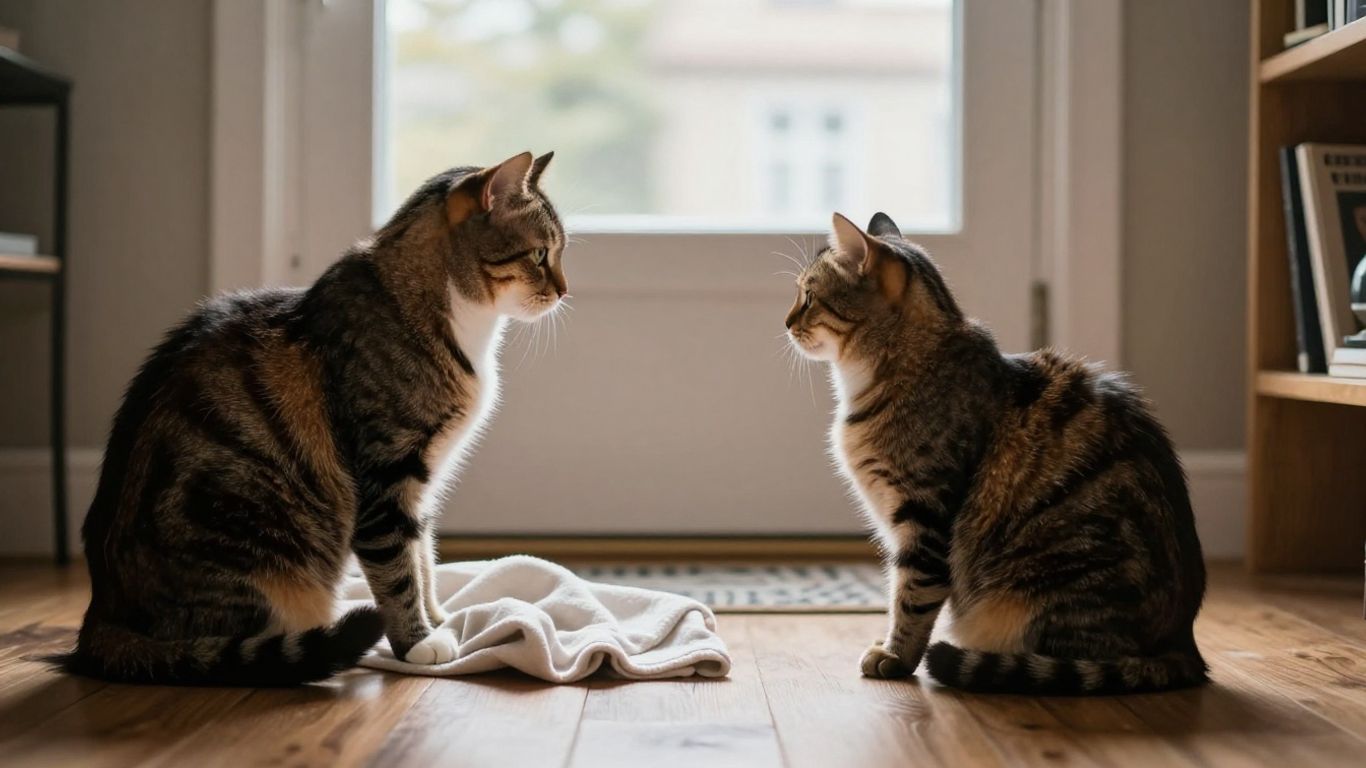
Cats gather plenty of information through smell, so scent can introduce the newcomer before the two cats see each other. This stage is quiet by design; there’s no need to put a blanket under either cat’s nose and demand a review. Give them time to investigate at a distance, then notice whether the smell becomes less interesting or still seems to worry them.
Swap bedding and soft items between their spaces
Place a small, soft item that has been used by one cat in the other cat’s space, then let them decide whether to approach it. A familiar blanket or bed cover can carry a trace of the other cat without bringing them face to face. If one cat avoids the item, leave it nearby rather than moving it closer. Curiosity may arrive later, after the new smell has stopped being the most interesting thing in the room.
Pair unfamiliar smells with treats or meals
If both cats are comfortable eating, you can let them encounter the other cat’s scent while enjoying a meal or a treat. Keep the item far enough away that each cat can eat without feeling crowded. The aim is a calm association, not a test of bravery; if a cat won’t eat or keeps watching the item instead, increase the distance and try again another time. Comfort matters more than speed when you’re building familiarity.
Watch for signs that either cat needs more time
Pay attention to what each cat does after noticing the scent. A cautious sniff followed by wandering off is different from repeatedly avoiding the area or staying tense. There’s no need to interpret every twitch as a verdict, but a cat that can’t settle may need a longer break from the new smell. Keep scent exchanges easy to ignore, and make the next step only when both cats seem reasonably relaxed in their own spaces.
Let them get acquainted through a closed door
A closed door lets the cats hear and smell each other while keeping a safe barrier between them. It’s a useful middle step: more information than a bedding swap, less social pressure than sharing a room. Keep the setup calm and predictable, and remember that a quiet day is not a race you need to win.
Feed them on opposite sides of the door
Offer meals on either side of the closed door, beginning far enough away that both cats can eat comfortably. If they manage that without fuss, you can gradually move the bowls closer over later meals. There’s no prize for putting the bowls right against the door on day one. Their ability to eat and then carry on normally tells you more than a dramatic but brief sniff at the gap.
Trade room access without letting them meet
Once the newcomer has had time in the starter room, you can let each cat explore the other’s space separately. Secure one cat elsewhere first, then allow the other to sniff around without a surprise encounter. This gives them a chance to investigate the shared household smells on their own terms. Swap who explores on another occasion, and return each cat to a familiar resting place afterwards.
Adjust the distance if growling or door-guarding persists
A growl or steady guarding of the door is a sign to make the interaction easier, not to push through it. Move food bowls farther from the barrier, shorten the session, or pause the exchange for a while. Keep the cats apart when you’re not actively managing the process. If the doorway becomes a place where one cat repeatedly waits or blocks the other, change the routine so both can move around without having to pass it.
Add visual contact without removing the safety net
When the cats are coping with the sounds and smells behind a closed door, you can try a brief look at one another. Keep a barrier in place so neither cat can rush across the room, and make sure you can end the view quickly. The first sighting may be uneventful, or it may come with staring and a little theatrical huffing; either way, keep the session short.
Use a secure gate, screen, or cracked door
Choose a barrier that stays firmly in place and prevents either cat slipping through. A secure gate or screen can work; if you use a cracked door, keep it controlled rather than relying on a hopeful wedge. Stay close enough to close the view if needed. The barrier should offer both cats a chance to see what’s happening without leaving either one exposed or unable to retreat.
Keep early glimpses brief and reward calm behavior
Start with a short view, then block it again while both cats are still managing. Offer praise, treats or a meal if those things help them stay settled. You’re looking for relaxed behaviour, not a perfect greeting: a glance, a sniff and turning away can all be perfectly useful. End on a calm note and repeat another time, rather than waiting until one cat has had enough and announces it loudly.
Block the view and try again later if tension rises
If either cat becomes fixed on the other, crouches, hisses repeatedly or tries to charge the barrier, calmly block the view. Give them room to settle separately, then return to an earlier step when you try again. Don’t scold them for reacting; the goal is to make the next glimpse feel less intense. A shorter session or a greater distance can turn a difficult moment into a manageable one.
Hold short, supervised meetings
A shared room is a bigger step, so start only when both cats have been coping with seeing each other through a barrier. Keep the first meetings supervised and make it easy to separate them without grabbing or chasing. You’re aiming for peaceful coexistence, not a nose-to-nose friendship montage.
Choose a spacious room with more than one exit
Pick a room with enough space for each cat to move away and more than one route out. Avoid introducing them in a narrow hallway or beside a favourite hiding spot where one cat might feel trapped. Make sure the newcomer and resident cat both have somewhere to retreat. Before opening the door, put away anything that could make the space harder to navigate, such as clutter that blocks a clear path.
Keep sessions brief and end while things are calm
For early meetings, a short session is often easier to manage than a long one. Watch for relaxed movement and the ability to look away, sniff around or focus on something else. If the cats are still calm, separate them before they become tired or tense. Ending early can feel almost anticlimactic, which is exactly the sort of drama-free result you’re after.
Use toys and treats without forcing interaction
A toy or treat can give each cat something pleasant to focus on, but keep enough space between them. Let each cat choose whether to play, eat or simply observe; don’t carry one over to the other for an introduction. If you use a wand toy, move it away from the other cat rather than encouraging a chase towards them. When the cats can share a room without being pushed together, they get a chance to form their own opinions.
Read the body language, not just the noise
Cats can communicate with a great deal of subtlety, and volume is only part of the picture. A hiss may mean “I need space,” while a quiet cat may still be feeling uncomfortable. Look at posture, movement and what each cat does afterwards, not just whether the room sounds peaceful.
Tell playful curiosity from fear or aggression
Curiosity often includes loose movement, brief approaches and the ability to turn away or explore something else. Fear or escalating conflict may look more rigid: flattened ears, a tucked or puffed-up body, prolonged staring, repeated swatting or attempts to flee. One gesture on its own doesn’t tell the whole story, so consider the sequence. If play starts to look one-sided or intense, give the cats a break rather than waiting to see who makes the next move.
Notice subtle signs of stress, including hiding or appetite changes
Changes in ordinary routines can tell you that the introduction is weighing on a cat. One cat may hide more than usual, avoid a familiar area or show less interest in food. Notice patterns rather than reacting to one quiet afternoon, and make sure each cat can access their own essentials without crossing paths. If a change is persistent or you’re concerned about a cat’s health, ask your veterinarian for guidance.
Separate calmly if either cat becomes overwhelmed
If one cat is overwhelmed, use a door or another barrier to separate them without reaching between their bodies. Keep your voice and movements steady, and let each cat return to a familiar space. Avoid picking up a tense cat if you can safely guide them away another way. Once they’ve had time apart, think about what made the meeting difficult and make the next attempt simpler.
Adjust the pace to the cats in front of you
Some cats settle into a new routine quickly; others need more time to accept another cat’s presence. A calendar can help you remember what you’ve tried, but it shouldn’t dictate when you move forward. The useful question is whether both cats are coping with the current step, not whether you’ve reached a particular day.
Use milestones instead of a fixed-day schedule
Set small milestones based on behaviour: each cat can eat near the closed door, explore the other’s space, or watch through a barrier and then disengage. Move on only when the current step is manageable for both cats. If one is ready and the other isn’t, follow the slower cat’s pace. That may mean repeating a quiet, uneventful stage more than once. Uneventful is underrated.
Take a step back after setbacks without treating them as failure
A tense meeting doesn’t erase the calmer ones that came before it. Separate the cats, give them a breather and return to whichever earlier step felt comfortable. You might shorten the next session, increase the distance between them or go back to scent swapping for a while. Think of a setback as useful information about what was too much, rather than proof the arrangement can’t work.
Ask a veterinarian or behavior professional for help when needed
If conflict keeps escalating, one cat seems unable to settle, or you’re unsure how to proceed, ask your veterinarian or a qualified cat behaviour professional for help. They can consider the situation and suggest appropriate next steps. Get support sooner if either cat is injured or you have a health concern. You don’t have to solve every feline mystery alone; some are best handled with an experienced guide.
Conclusion
Introducing cats slowly is less about following a perfect timetable and more about giving both animals room to feel safe. Start with separate spaces, build familiarity through scent and a closed door, then add brief visual and in-person meetings when they’re ready. Keep watching, adjust when needed, and let calm, ordinary moments—not the calendar—tell you when to take the next step.
Frequently Asked Questions
How long does it take to introduce two cats?
There’s no single timetable that suits every pair. Some cats may become comfortable with each step sooner than others, so move forward according to how both cats are coping rather than a fixed number of days.
Should I let the cats work it out themselves?
It’s safer to supervise introductions and give each cat a way to retreat. If tension rises, separate them calmly and return to an easier step instead of expecting them to resolve a difficult encounter alone.
What if one cat hisses at the other?
A hiss can be a request for space. End or ease the interaction, give both cats room to settle, and try again later with more distance or a shorter session.
Can I swap the cats’ rooms during the introduction?
You can let each cat explore the other’s space separately, once the newcomer has had time to settle. Make sure one cat is safely elsewhere before the other explores, so they don’t meet unexpectedly.
When can I remove the barrier between them?
Wait until both cats can see each other through a secure barrier without becoming overwhelmed. Begin any shared-room meetings briefly and under supervision, with clear ways for each cat to leave.
What should I do if the cats fight?
Separate them using a door or another barrier rather than reaching between them. Give them time apart, then consider returning to an earlier introduction step. If conflict persists or either cat is injured, seek appropriate professional guidance.
Is it a problem if the cats never become friends?
Some cats may learn to share a home peacefully without becoming close companions. A calm routine with separate resources and room to avoid each other can be a perfectly reasonable outcome.